Professional MLOps & LLMOps Engineering Course
Take your Artificial Intelligence skills beyond model training with ISDI Professional MLOps & LLMOps Engineering Course. Learn how to manage Machine Learning workflows, track experiments, deploy AI models, automate CI/CD pipelines, monitor production systems, and run Large Language Models locally.
What Makes This MLOps & LLMOps Course Special?
Learn industry-relevant MLOps and LLMOps skills through hands-on training, real-world projects, AI model deployment, CI/CD automation, and production monitoring. Gain practical experience with MLflow, Docker, FastAPI, AWS S3, Prometheus, Grafana, and Ollama to build, deploy, and manage AI-powered applications.
Professional MLOps & LLMOps Engineering Course
Explore our comprehensive 2-month MLOps & LLMOps course covering Machine Learning operations, data versioning, experiment tracking, model deployment, Docker containerization, CI/CD pipelines, cloud storage, production monitoring, and local Large Language Models through practical labs and a final capstone project.
Duration
2 Months
Mode
On-site & Online
Sessions
16
Week 1 – MLOps & LLMOps Foundations
Understand the fundamentals of production Machine Learning and the differences between model development and deployment.
Topics Covered:
-
Introduction to MLOps and LLMOps
-
Python project structure
-
Git fundamentals: commits, branches, and pushing changes
-
Training and saving a basic ML model
-
Understanding reproducible Machine Learning workflows
Practical Activity: Train and save a small Machine Learning model.
Week 2 – Data Versioning & Reproducibility
Learn how to organize, manage, and version datasets so experiments can be repeated consistently.
Topics Covered:
-
Introduction to Data Version Control (DVC)
-
Dataset versioning
-
Managing raw and processed data
-
Data splitting and leakage prevention
-
Organizing datasets and model artifacts
Practical Activity: Version a dataset and retrieve it in another working environment.
Week 3 – Experiment Tracking with MLflow
Learn to record, compare, and manage Machine Learning training experiments.
Topics Covered:
-
Introduction to MLflow
-
Tracking parameters and metrics
-
Recording model artifacts
-
Comparing training runs
-
Selecting models based on evaluation results
Practical Activity: Track and compare multiple model experiments using MLflow.
Week 4 – Model Serving & API Development
Learn to make a trained Machine Learning model accessible through an API.
Topics Covered:
-
Introduction to FastAPI
-
REST API fundamentals
-
Model prediction endpoints
-
Request validation
-
Health checks and application logging
Practical Activity: Build and test an API that returns predictions from a trained model.
Week 5 – Docker & Containerization
Understand how containers help package applications and make them easier to run across environments.
Topics Covered:
-
Docker fundamentals
-
Writing Dockerfiles
-
Building container images
-
Running applications inside containers
-
Docker Hub image management
-
Pushing and pulling container images
Practical Activity: Containerize a Machine Learning API and publish its image to Docker Hub.
Week 6 – CI/CD Automation & AWS S3
Explore automated delivery workflows and cloud-based storage for Machine Learning projects.
Topics Covered:
-
CI/CD fundamentals
-
Automated testing and builds
-
Container image publishing workflows
-
Introduction to AWS S3
-
Uploading and retrieving datasets
-
Managing model artifacts in cloud storage
Practical Activity: Build a CI/CD workflow and store project artifacts in AWS S3.
Week 7 – Monitoring with Prometheus & Grafana
Learn why monitoring is important after a Machine Learning application has been deployed.
Topics Covered:
-
Introduction to production monitoring
-
Prometheus metrics collection
-
Monitoring API requests and errors
-
Tracking application latency
-
Grafana dashboards
-
Understanding service performance indicators
Practical Activity: Create a monitoring dashboard displaying application traffic, errors, and response times.
Week 8 – LLMOps & Final Capstone Project
Explore the fundamentals of operating local Large Language Models and bring together the course technologies in a practical project.
Topics Covered:
-
Introduction to LLMOps
-
Running local models with Ollama
-
Using Qwen models
-
Understanding tokens and prompts
-
Exploring models through Hugging Face
-
Introduction to Kubernetes concepts
-
Final capstone presentation
Practical Activity: Run a local LLM and present a complete MLOps-based application.
Fee structure of this program
Premium educational pricing with exclusive early-bird benefits
Total Program Fee:
Rs.24,000/-
Rs.19,500/-
- Live instruction from Industry Veterans
- Vibrant community just like a College Campus
- Hand-on curriculum with Real-Life Projects
Real Results from Real Students
Real feedback from learners who experienced skill-focused training at ISDI.
Who Should Enroll?
Meet Your Mentor
Hussain Ali Bukhari
Full-Stack & AI Automation Engineer
Hussain Ali Bukhari is a Full-Stack & AI Automation Engineer with 5+ years of experience building AI-driven products and production web platforms. He specializes in integrating large language models and AI agents into business-critical systems — architecting agent-driven automation, orchestrating long-running AI pipelines with Temporal workflows, and combining LLMs (OpenAI, Cohere) with tools like Google Cloud Vision OCR to automate document processing and decision-making. Backed by Node.js and React/Next.js on AWS and GCP, and experience shipping an enterprise SaaS serving 5,000+ users, his practical, result-oriented approach helps businesses turn AI capabilities into reliable products that ship and scale.
Talk to us in-person
Get the ISDI Campus Experience
- Walk into ISDI Campus for a free 1:1 session
- Chat with an expert about your career in digital
- Experience the campus vibe before you commit
Get Certified & Stand Out
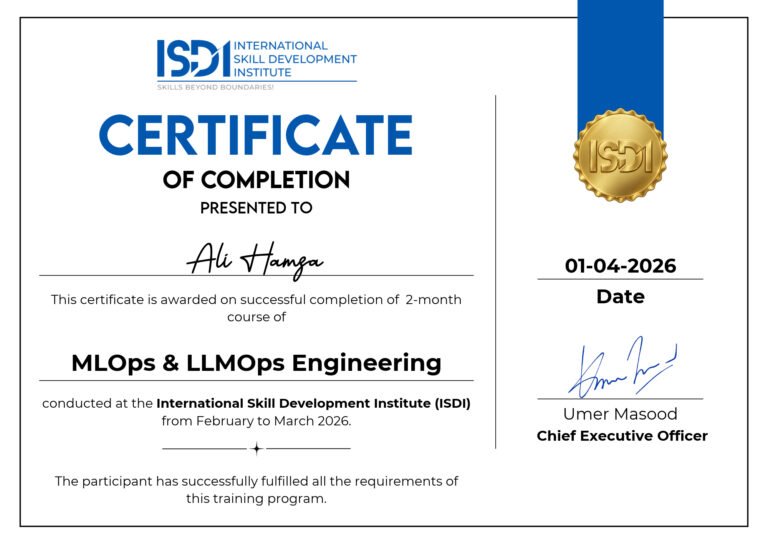
Upon successful completion of the Professional MLOps & LLMOps Engineering Course, receive a certificate from ISDI recognizing your practical training in AI model deployment, experiment tracking, CI/CD automation, cloud storage, and production monitoring. Showcase your technical knowledge and hands-on project experience to potential employers.
- Certificate of Completion from ISDI
- Recognizes your MLOps & LLMOps technical skills
- Demonstrates hands-on experience with industry-relevant tools
- Boost your resume and LinkedIn profile
- Showcases your practical projects and cloud automation skills
Frequently Asked Questions
Get your every question answered here.
Are Online and Physical Classes Available
Yes, ISDI offers Online and Physical (On-Campus) Classes for the Professional MLOps & LLMOps Engineering Course, allowing students to choose their preferred learning mode.
What is the difference between MLOps and LLMOps?
MLOps focuses on managing the lifecycle of Machine Learning models, including reproducibility, experiment tracking, deployment, and monitoring. LLMOps applies related operational practices to Large Language Models, including model execution, integration, and deployment considerations.
How Can I Enroll in the Course?
You can apply online through the ISDI website or contact our admissions team directly on +92 332 3473475 for enrollment and further details.
Who Can Join This Course?
The program is suitable for:
-
CS & IT Students: Build practical AI skills.
-
Fresh Graduates: Explore AI career opportunities.
-
Python Developers: Learn AI deployment and automation.
-
Data Scientists: Master MLOps workflows.
-
DevOps Engineers: Expand into AI infrastructure.
-
AI Enthusiasts: Explore LLMOps and AI technologies.
Is previous experience in Machine Learning required?
The course introduces MLOps and LLMOps concepts, but it also involves Python, model training, APIs, and development tools. Familiarity with basic Python programming and Machine Learning concepts is recommended for getting the most from the practical exercises.
Where are physical classes conducted?
Physical classes are conducted at ISDI Ghalib Market Campus, located at 1st Floor, 67-A/2, Ghalib Market, Gulberg III, Lahore.
Will I learn Docker and Kubernetes?
Yes. Students practice Docker containerization and Docker Hub workflows. Kubernetes is introduced at a foundational level, rather than as a complete Kubernetes administration course.
Does the course cover AWS Cloud?
Yes. The curriculum includes AWS S3 for storing datasets and model artifacts. It focuses on S3 integration rather than comprehensive AWS cloud administration.
Do I receive a certificate after completing the course?
Yes. Students receive an ISDI physical certificate.
Start Your MLOps & LLMOps Journey with ISDI
Move beyond training AI models and learn how to manage, deploy, automate, and monitor Machine Learning applications.